

We’ve observed that:
CEO/CROs don’t understand the challenges a bad data stack presents for their GTM execution and consequently don’t invest (the people, $ and time) to get it right.
There is no standard definition of the layers in the GTM data stack, particularly one that is vendor-agnostic
We are writing this article to help drive alignment / clarity to ensure every company invests in the GTM data stack thoughtfully. This article is focused on internal data and having the data stack to successfully build agents on. You’ll likely also want to integrate external data sources like enrichment and signals (not covered here but critical for your GTM)
The Layers of the GTM Data Stack
Note: There is a proliferation of tools for the data stack - our report is not exhaustive but rather illustrative to help executives understand the data stack. We’ve included the prominent vendors along with a few new startups - this list of examples is not exhaustive.
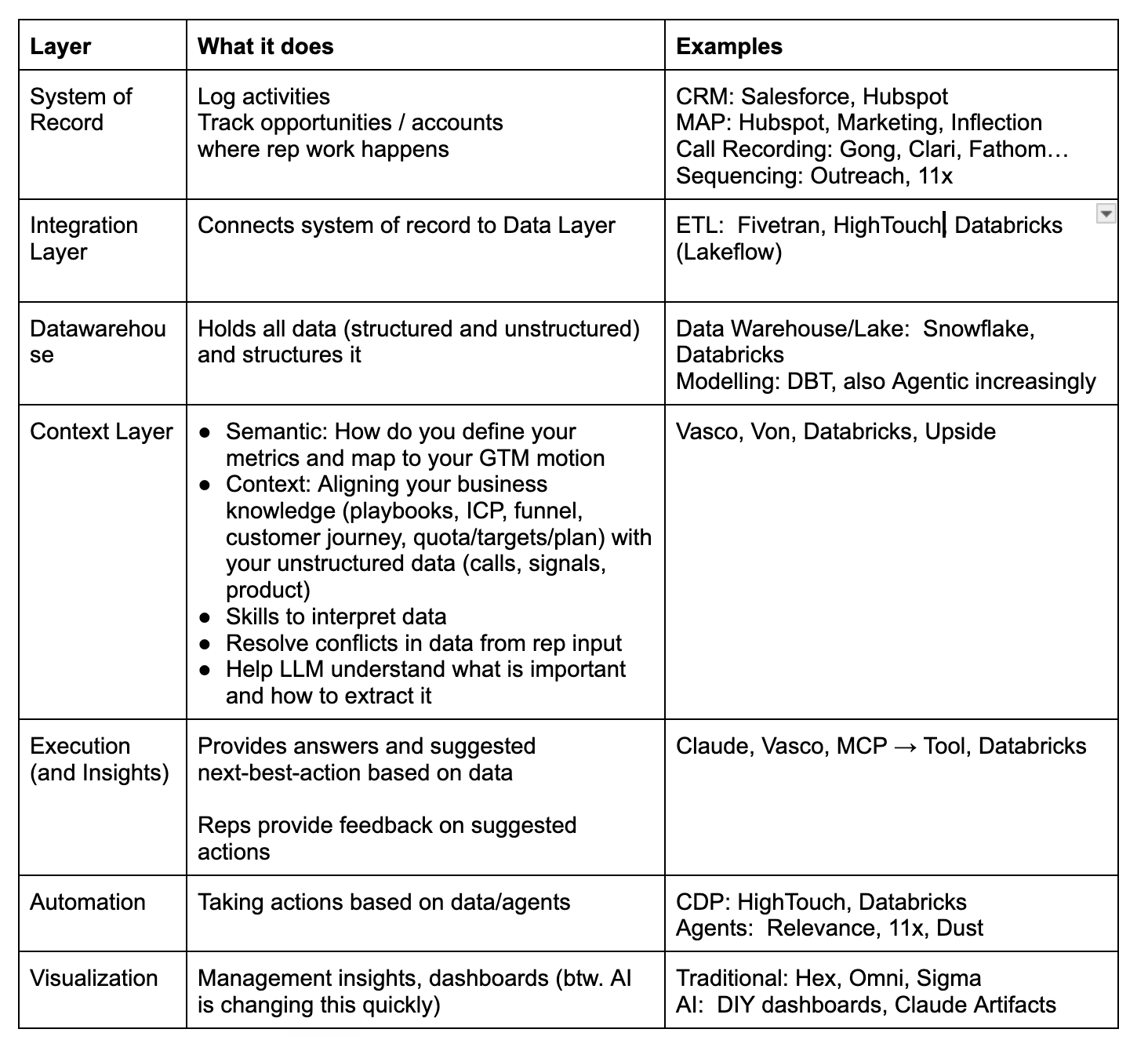
Why the context layer is critical
Any halfway decent GTM engineers can quickly throw together a v1 app built directly on the system of record but these won’t scale because:
They aren’t accurate: The LLMs analyzing each query in a world without a context layer will often interpret data differently query-by-query
They aren’t efficient: LLMs that are querying unstructured data can be much more expensive than leveraging structured data
They don’t learn: Without a context layer that leverages your business knowledge and learns / improves, your agents will just be dumb spam-cannons
They aren’t fast: If agents have to analyze all raw unstructured data each time, they will have long latency and not be able to move at the speed your business needs.
They don’t scale: Without data structuring and context, your execution will grind to a crawl.
They will struggle with conflicts: Without a single source-of-truth, your agents may have conflicts when pulling from multiple systems.
They won’t be able to analyze trends: Most systems of record don’t snapshot data, leaving your GTM blind without complete timelines to analyze.
They can break and be hard to fix: You need access control, lineage and the ability to audit changes in data to be able to diagnose and fix problems.
If you want to truly leverage AI to drive your business, you need to invest in the data foundation.
Why LLMs won’t replace context layer
The models will keep improving, but a better model never becomes your data layer, for a few reasons:
The knowledge isn’t in your data: Your definitions, your plan, your identity map, and your win and loss history were never written down anywhere the model can read. That context has to be authored, not inferred.
MCP is access, not architecture: It plumbs the model into your systems and gives it the pipes. It was never meant to be the layer that reconciles identity, enforces meaning, and remembers outcomes between them.
The labs are infrastructure, not the application: Anthropic and OpenAI are to AI what AWS and Azure are to the cloud, the horizontal layer everything runs on. The hyperscalers did not build the software that won each market; Snowflake, ServiceTitan, and Procore did, on top of them. Sequoia argues the same holds for AI, that value accrues to the vertical application layer, not the platform. As Bret Taylor put it on Sequoia’s podcast, “I am fairly skeptical of horizontal AI platforms.” The per-company GTM context layer is exactly what the giants leave to specialists.
If you want to leverage AI to drive your business, the model is not the part you have to own. The context is.
Do I need a data warehouse?
TLDR:
If you have a mature data team and want to own and build everything end to end on one open platform, platforms like Databricks are the right call.
If you want RevOps to own the GTM definitions and context and move at the speed of the motion rather than data-team sprints, there are other options (i.e. Vasco, Upside).
If you have no warehouse or data team to start with, Vasco gives you the whole GTM stack, warehouse included, out of the box.
The real question is who builds and owns the GTM context layer on top of the data warehouse.
Build it on Databricks and you are looking at a data team and roughly 12 to 18 months. With engineers you can build almost anything on it, a GTM semantic layer and a customer 360 included. The harder part is who owns it after. Your data and BI team supports the whole company, finance, product, support, and go-to-market, so they sit far from the motion, and the definitions have to travel from RevOps through a business analyst into a ticket and a sprint. RevOps owns those definitions and has to change them the week the motion changes, not a quarter later. In the age of agents that speed is the moat, which is what Kyle Norton and Guillaume (CEO of Vasco) wrote about in “Speed is the new moat.”
Nice article Andy
Thank you for including Upside :)